Your agent deploys.
Your server keeps it.
An open-source platform for apps you build with AI: your agent deploys over MCP, and code, data and audit trail stay on your server.
AGPL-3.0, for Ubuntu 22.04+. Sandbox first; production needs an explicit per-app permission.
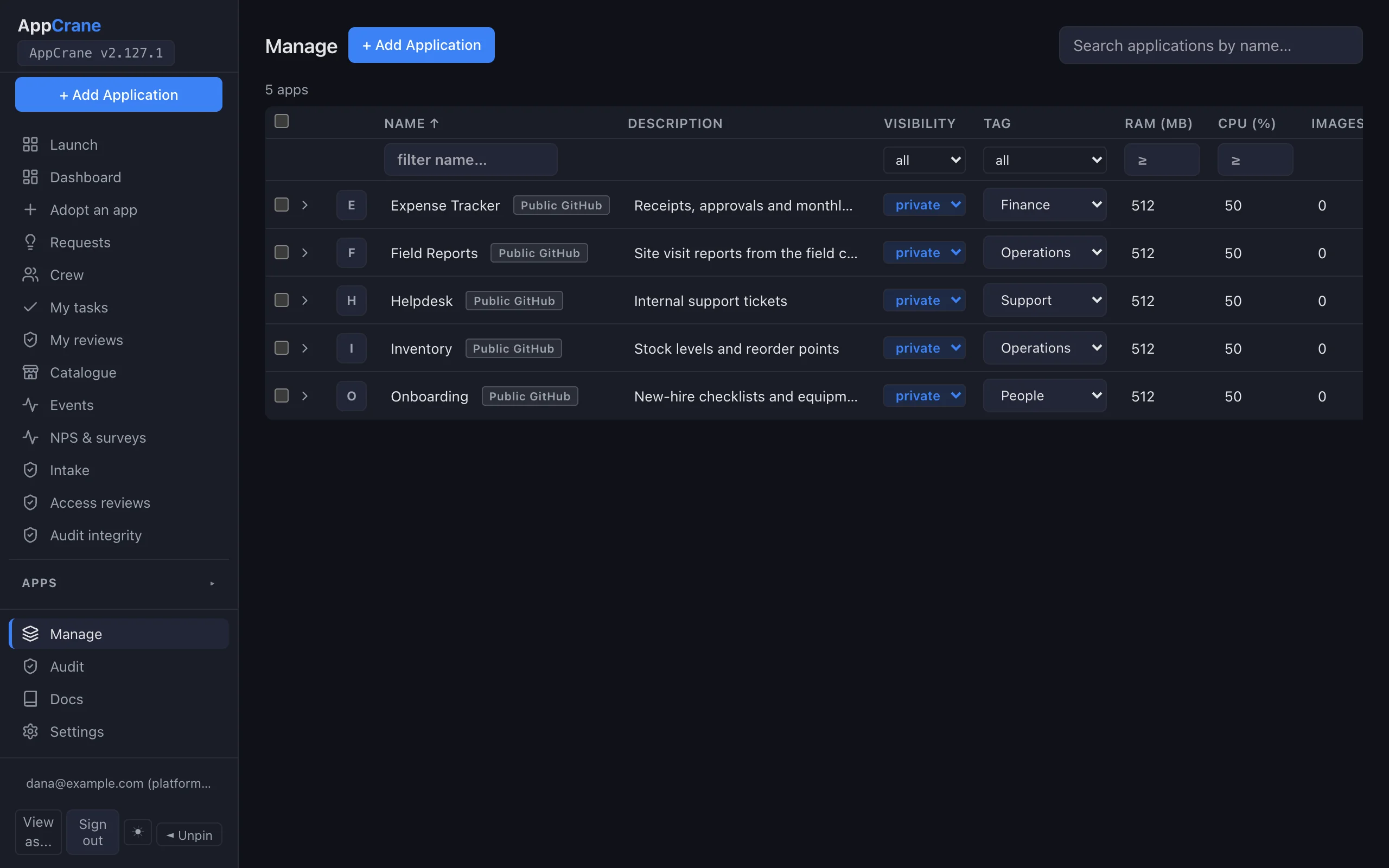
Your agent runs the deploy.
Connect Claude Code, Cursor, Codex CLI or any MCP client. The agent creates the app, sets its secrets, deploys, promotes and rolls back. Every call is bound to the user whose token it carries.
Deploy from Claude →# The agent creates the app → appcrane_create_app(slug: "inventory") ✓ App inventory created. Caddy route wired. # Deploy: clone, verify, build, health-check, swap → appcrane_deploy(slug: "inventory", stage: "sandbox") ✓ Health check passed. Deploy #12 live.
Sandbox first. Production on purpose.
Every app gets production and sandbox. Deploys go to sandbox by default, and production needs an explicit per-app permission. Sandbox gets its own database, promote pins the exact commit that passed sandbox, and a rollback returns to a retained release without a rebuild.
The workflow →Every action has an actor.
The audit log records each action against the user who took it and tags it agent or human. Rows are sealed into a SHA-256 hash chain with signed checkpoints, and you can stream them to your SIEM so a third party holds a copy.
For IT managers →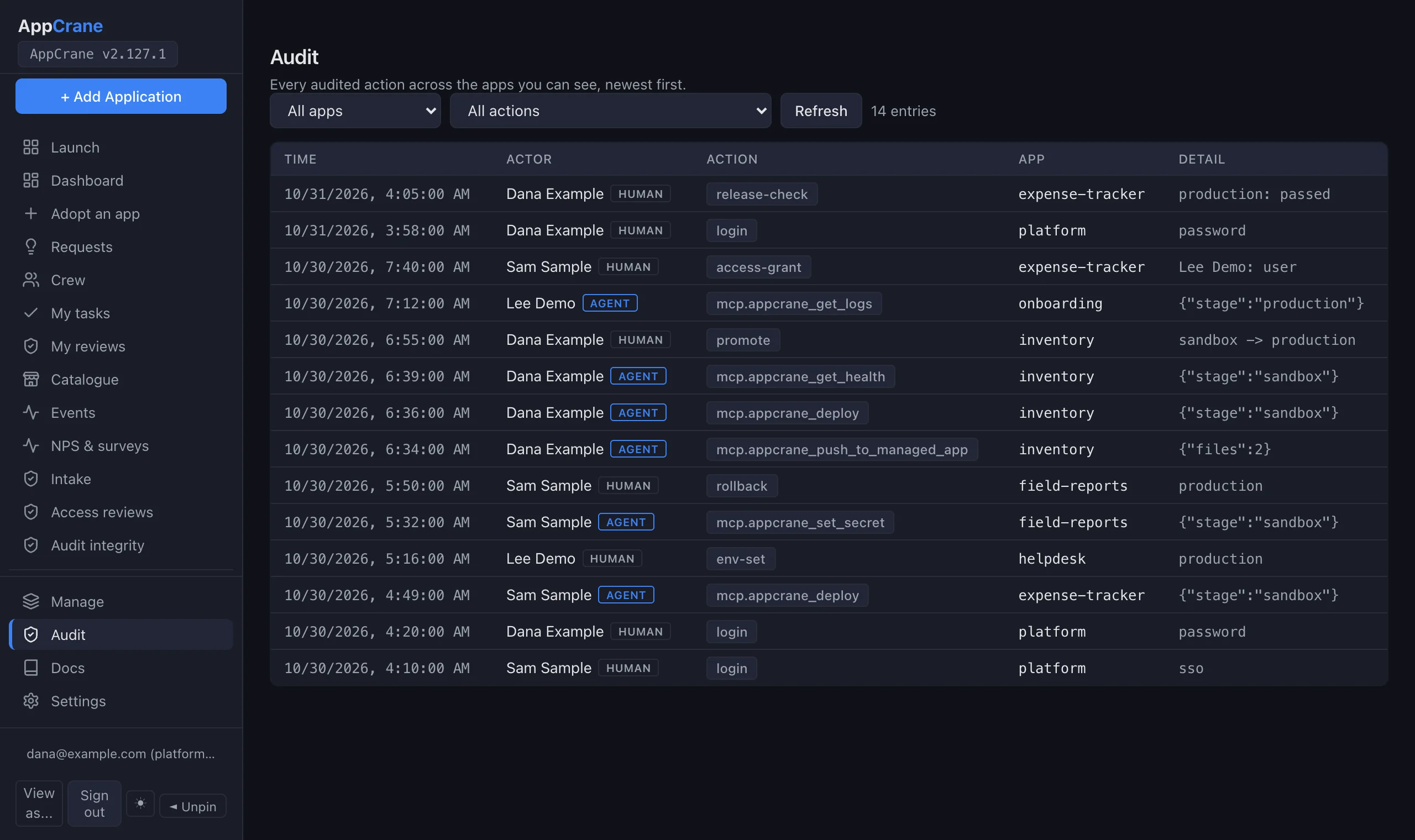
Apps stay apart.
Each app runs in its own Docker container, and managed databases give each app its own login. App secrets are encrypted at rest, and the person who installs and updates the platform cannot read them for an app they are not assigned to. Signed identity headers let an app reject identity that did not come through AppCrane, and with app isolation on, each app gets its own web address, so one app cannot act as you inside another.
The security model →- own container
- encrypted secrets
- own database login
- own container
- encrypted secrets
- own database login
Every hosted app is scanned for you.
AppCrane checks the dependencies of every app it hosts, at each deploy and again every day, with no setup by the app’s team: no CI step, no scanner, no tokens. A newly found vulnerable package is e-mailed to the app’s owners once, in plain words, and opens a request in the app’s queue that closes itself once a later scan no longer finds it. A fixable one holds production releases until it is upgraded, or until someone records an exception with a reason and an expiry.
How scanning works →The server looks after itself.
A full disk or a reboot no longer takes apps down quietly. AppCrane refuses a deploy or update when less than 5 GB is free, brings back an app whose container went missing from its live release, and checks the server every day for pending security updates. Platform admins see the host’s log caps, disk reserve and automatic security updates in Settings and can apply them from there.
Operations detail →Aligned with SOC 2. Evidence included.
Controls built to support SOC 2, a signed evidence pack mapped to SOC 2 CC6, CC7, CC8, A1 and C1, and a FIPS 140-3 mode. AppCrane is self-hosted software, so the SOC 2 audit is of your environment: AppCrane provides the controls and the evidence pack, not a SOC 2 report or a certification.
Controls and evidence →Open-source apps in one click.
Deploy an app from a curated open-source catalogue onto your own server in one click. It runs in its own container on your box, behind your SSO and audit trail.
 Akaunting
 Lightdash
 EspoCRM
 Bagisto
 Element
 Mayan EDMS
 AFFiNE
 Apache OFBiz
 Documenso
 Formbricks
 Frappe HR
 Chatwoot
Who runs AppCrane.
One platform, read from the seat you sit in.
Install it on your own server.
One command on a fresh Ubuntu server.
curl -fsSL https://raw.githubusercontent.com/gitayg/appCrane/main/install.sh | sudo bashGet release updates or follow the changelog.